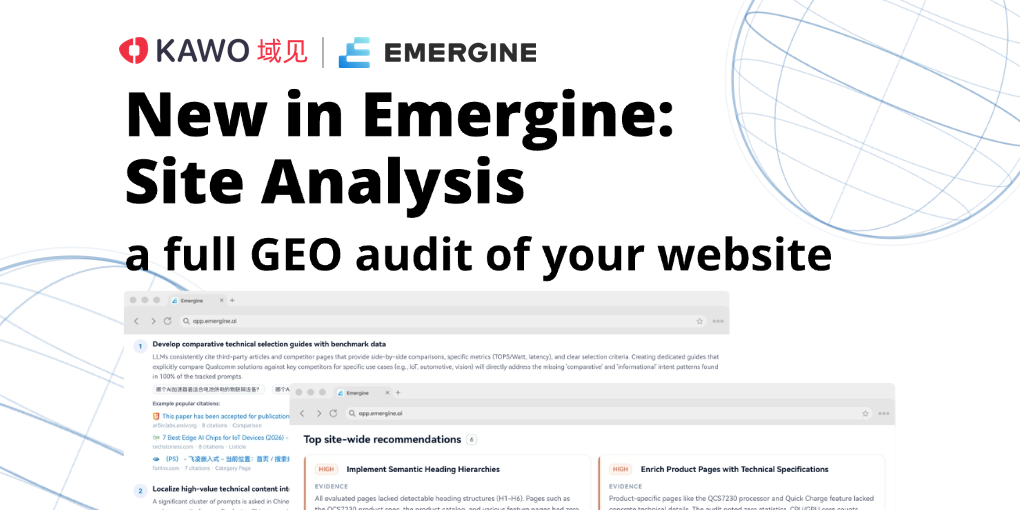
New in Emergine: Site Analysis, a full GEO audit of your website
Emergine shows you what AI engines say about your brand: where you are mentioned, how you rank against competitors, and which sources the engines cite when they answer. Site Analysis audits your own website against what AI engines need in order to find it, read it and quote it, and returns a prioritized list of changes to make.
An audit starts with one domain. You choose which checks to run, set how many pages to crawl, pick English or Chinese for the insights, and start the run. Results sit in the same project as your tracked prompts, so every recommendation traces back to questions your buyers are asking.
Four checks, one run
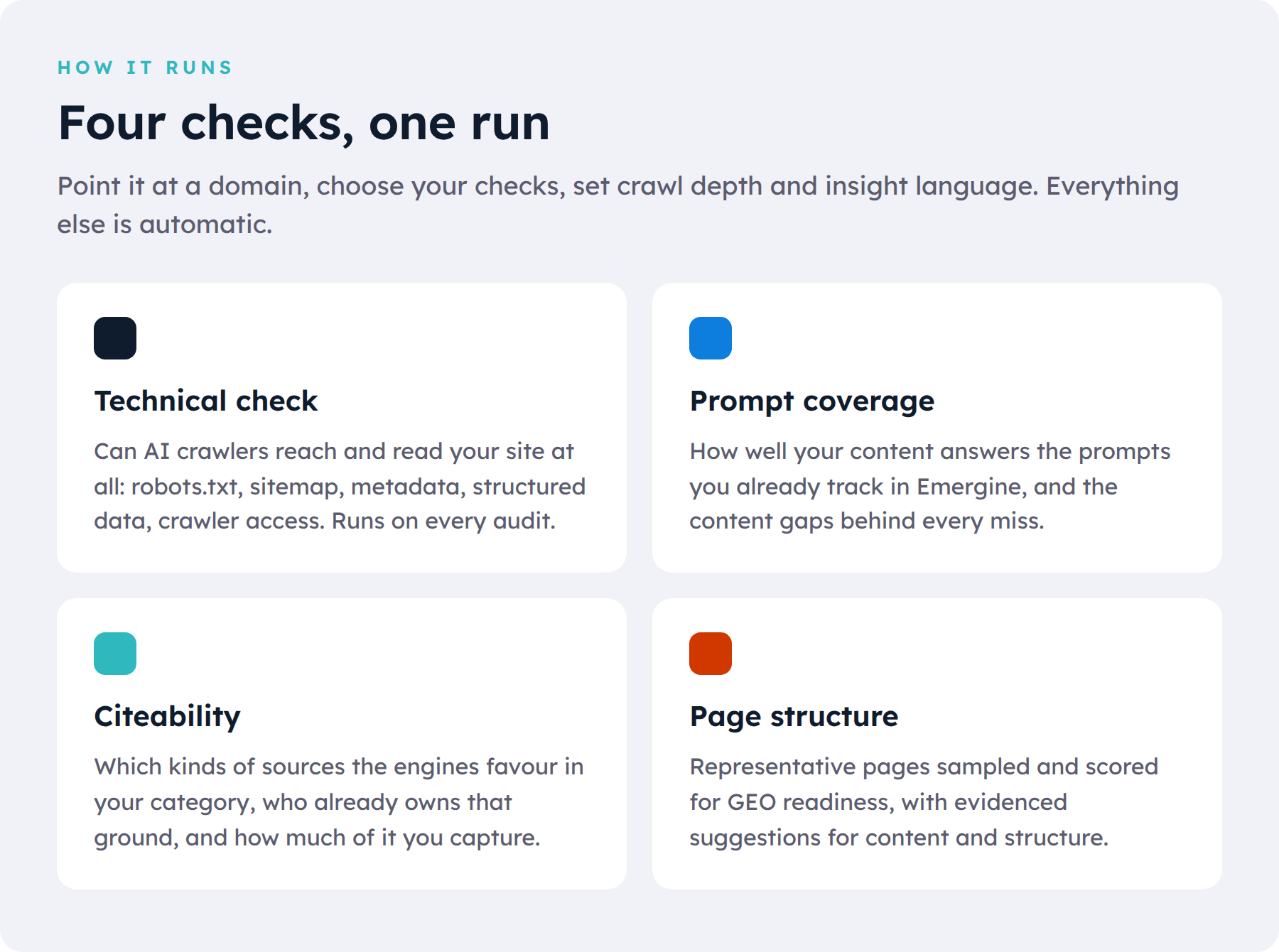
The Technical Check runs on every audit. Page Structure, Prompt Coverage and Citeability Analysis can each be switched on or off per run. The Check site size button shows how large the site is before you start the run.
Technical check: can AI engines reach and read your site?
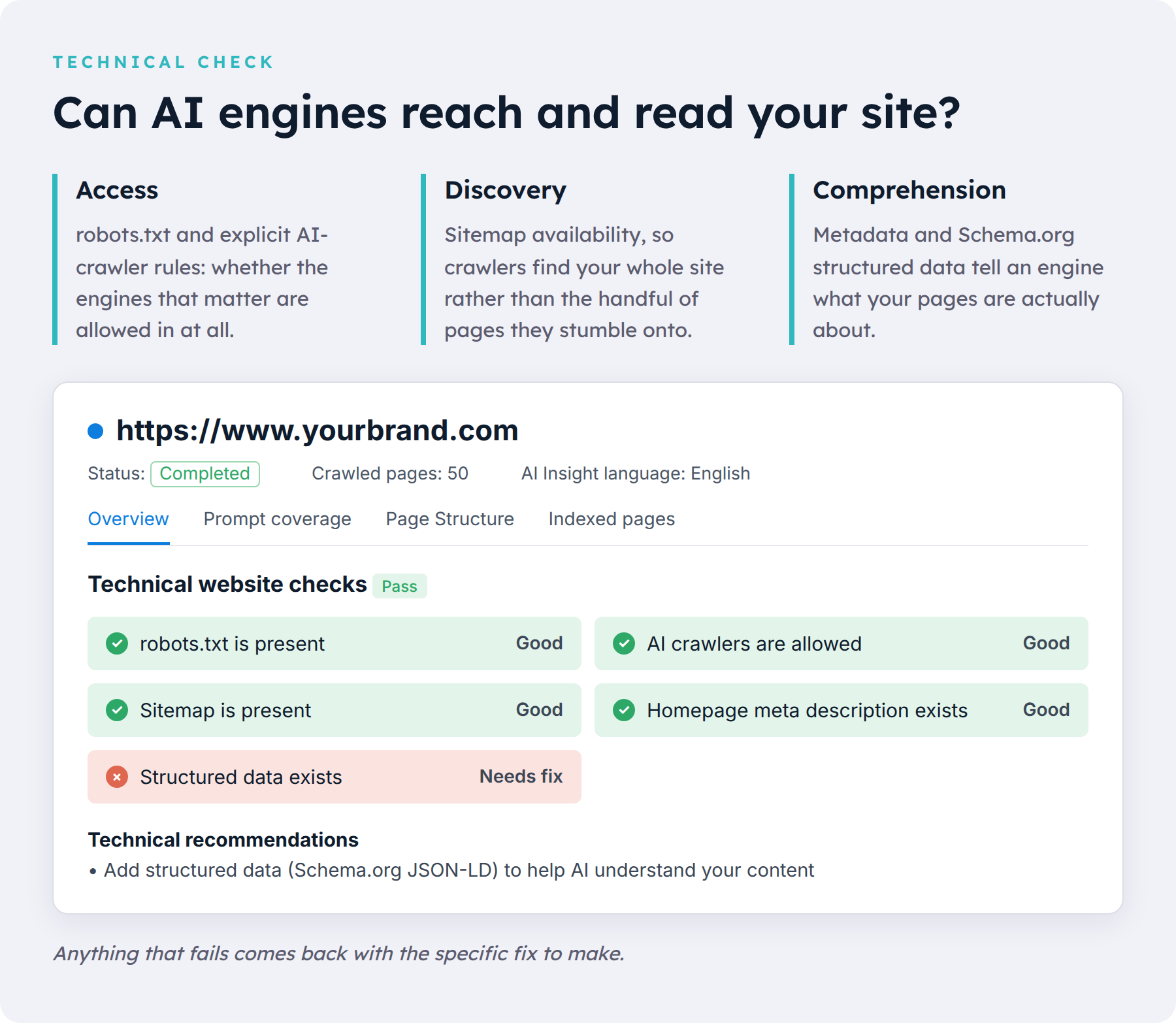
The technical check confirms that AI crawlers can get into your site and make sense of it. It covers three layers:
- Access. robots.txt and explicit AI-crawler rules, which decide whether the engines that matter are allowed in at all.
- Discovery. Sitemap availability, so crawlers find your whole site rather than the handful of pages they stumble onto.
- Comprehension. Metadata and Schema.org structured data, which tell an engine what each page is about.
Each item comes back as Good or Needs fix. Anything that fails is paired with the specific change to make. When structured data is missing, for example, the recommendation is to add Schema.org JSON-LD to the affected pages.
Prompt coverage: what your content can and can't answer
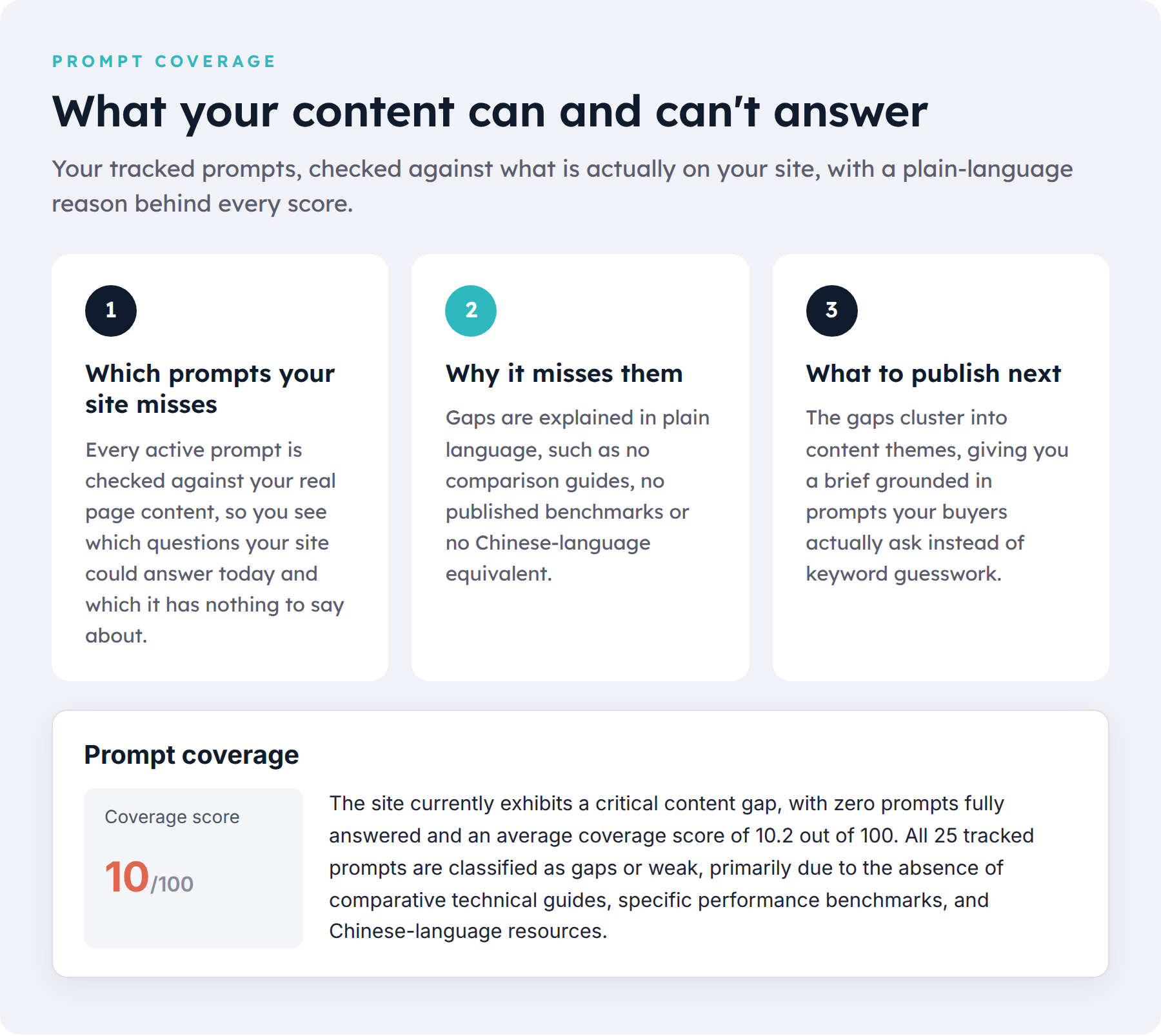
Prompt coverage takes the prompts you already track in Emergine and checks each one against the content published on your site. You get a coverage score out of 100, with three layers of detail under it:
- Which prompts your site misses. You see which questions your site could answer today and which it has nothing to say about.
- Why it misses them. Each gap is explained in plain language, such as no comparison guide, no published benchmarks, or no Chinese-language equivalent.
- What to publish next. The gaps cluster into content themes, which gives your team a brief built from prompts buyers actually ask instead of keyword guesswork.
In a recent audit of a global semiconductor brand, the site scored 10 out of 100. None of its 25 tracked prompts was fully answered, and the audit traced the gaps to three missing content types: comparative technical guides, specific performance benchmarks and Chinese-language resources.
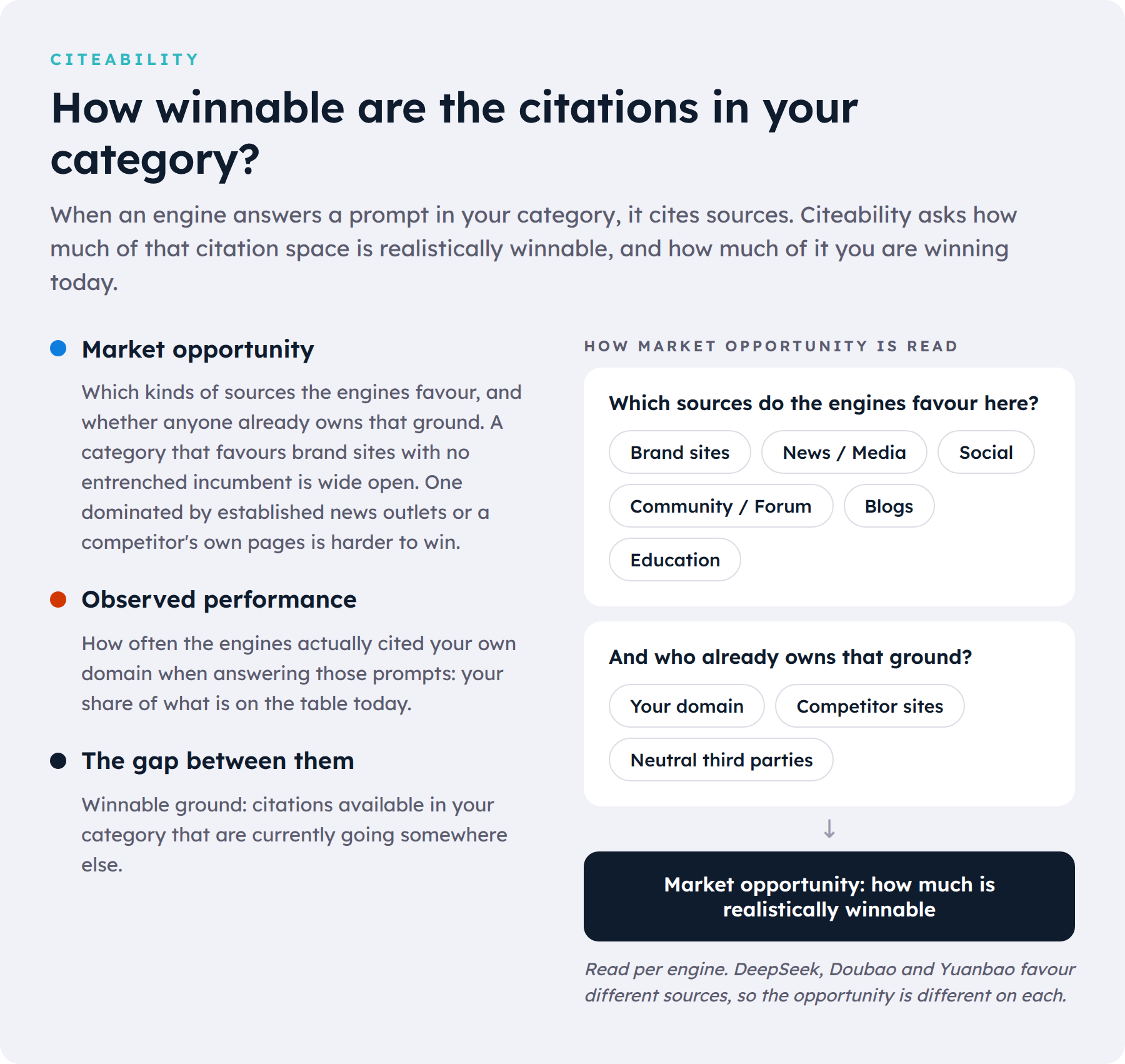
Citeability: how winnable are the citations in your category?
When an engine answers a prompt in your category, it cites sources. Citeability measures how much of that citation space you could realistically win, and how much of it you are winning today.
- Market opportunity reads the citation pattern behind your prompts. It shows which kinds of sources the engines favour (brand sites, news and media, social, community forums, blogs, education) and who already owns that ground: your domain, competitor sites or neutral third parties. A category where the engines favour brand sites and no incumbent dominates is wide open. One dominated by established news outlets or a competitor's own pages is harder to win.
- Observed performance is how often the engines cited your own domain when answering those prompts.
- The gap between them is your winnable ground: citations available in your category that are currently going somewhere else.
Citeability is read per engine. DeepSeek, Doubao and Yuanbao favour different kinds of sources, so the opportunity differs on each, and Site Analysis reports each engine separately.
Page structure: sampled pages, scored for GEO readiness
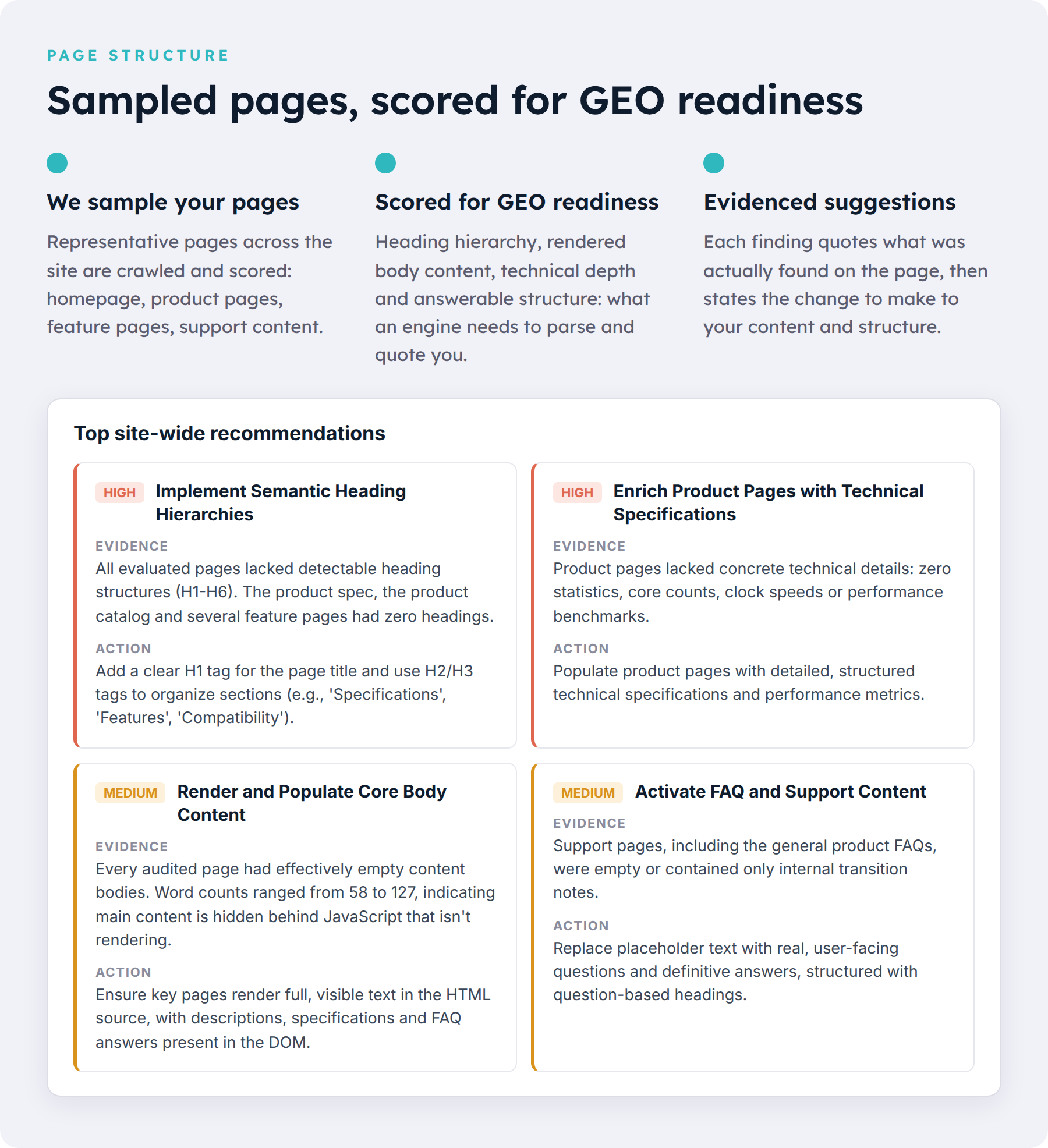
Site Analysis samples representative pages across your site, including the homepage, product pages, feature pages and support content, and scores each one for GEO readiness. The scoring looks at heading hierarchy, whether body content actually renders, technical depth, and whether the page is structured so an engine can parse and quote it.
Every recommendation carries a priority, the evidence found on the page and the action to take. In the semiconductor audit, the top findings included pages with no H1 to H6 headings at all, product pages without specifications or benchmarks, and page bodies of 58 to 127 words because the main content depended on JavaScript that was not rendering for crawlers.
Suggestions traced to real prompts and real citations
Prompt coverage and citeability results roll up into a ranked list of actions. Each action shows:
- the tracked prompts it would unlock, in the language they were asked in
- example citations the engines use today for those prompts, with citation counts and page type, so you can see exactly which competitor or third-party pages you would be up against
- Chinese and English prompts side by side, which exposes where a translated deep-dive would win the citation
For the semiconductor brand, the top three actions were comparative selection guides with benchmark data, Chinese-language versions of its key technical content, and architectural deep-dives explaining heterogeneous computing.
What teams get
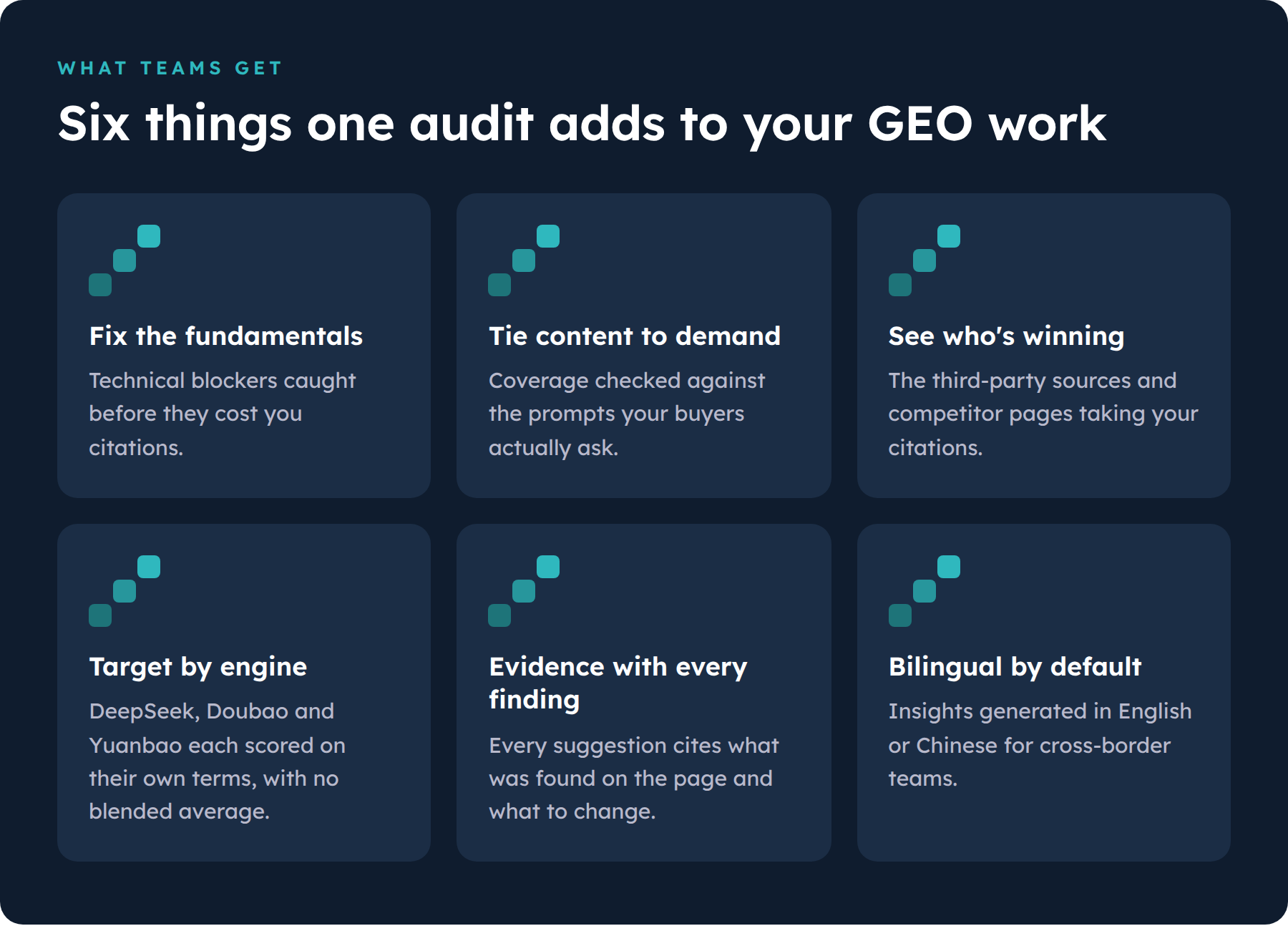
Insights can be generated in English or Chinese, so the people on both sides of a cross-border account work from the same audit.
Common questions
Do I need tracked prompts before running an audit?
Prompt coverage and citeability work from the prompts in your Emergine project. The technical check and page structure analysis run on the crawl of your site.
Which checks are required?
The technical check runs on every audit. Page structure, prompt coverage and citeability analysis can be selected per run.
What language are the insights in?
English or Chinese, set per audit. The setting controls the language of the AI-generated summaries, insights and recommendations in the report.
Start a 7-day free trial, or book a demo to see plans and pricing tailored to your organization.